|Image=[[File:Minthal City 01.jpg|center|frameless]]
|Type=Capital of the [[Minthari]]
|Type=Capital City
|Location=[[Anvil Range]]
|Location=Southern Orinilure Mountains, north of Biulu
|Realm=[[Terasil]]
|Realm=Orinilure
|Inhabitants=Minthari
|Region=Orinilure Mountains
|Inhabitants=Oinien, Himoja
|Significance=Capital of the Orinilure Collective and largest city in Orinilure
|Controlled by=Orinilure Collective
}}
}}
{{Settlement Sections
{{Settlements in Orinilure Sections
|Introduction='''Minthal''' is the capital of the Minthari civilization, a sprawling underground metropolis carved into the heart of the Anvil Range. Hidden deep within ancient stone, Minthal is a city of vast caverns, interconnected tunnels, and towering subterranean forges. As the political, economic, and spiritual center of the Minthari, it serves as both a fortress and a sanctuary, sheltering its inhabitants from the surface world while housing some of the finest metallurgical and engineering wonders in [[Adaris]].
|Introduction='''Orinilure City''' is the capital of the [[Orinilure Collective]] and the largest city in [[Orinilure]], with about 70,000 inhabitants. It is an underground city of chambers and tunnels in the southern [[Orinilure Mountains]]. Most of its people are [[Oinien]], and [[Himoja]] live among them. It is the political and economic center of the Collective and a major center of mining and metalworking.
|Geography=Minthal is a vast, multi-layered network of tunnels, chambers, and carved-out spaces, forming a labyrinthine metropolis deep within the Anvil Range. The Minthari have sculpted their home directly from the rock, shaping every passageway, cavern, and forge.
|Etymology=The city is named for the region. ''Orinilure'' is [[Arânzeni]] in origin and means "land of the booming voice".
|Geography=Orinilure City lies in the southern part of the Orinilure Mountains, north of [[Biulu]] and south of [[Lirandi]]. It is entirely underground. The city is built on several levels, with tunnels running above and below one another and joined by ramps and shafts. Its main thoroughfares are the Grand Tunnels, which are part of the [[Deep Roads]].
Minthal’s structure is defined by:
The Oinien are nearly blind and find their way through the city by echolocation. Chimes mark junctions and important buildings, and floors are textured differently from one street and district to the next.
|History=The site was a set of natural caverns with passages left by the [[Namuril]] from the [[Great Erosion]]. The settlers who entered the Orinilure Mountains in 150 ME took shelter there, and the city was founded in 152 ME as their first settlement in the range. It grew outward and downward from these caverns over the following centuries.
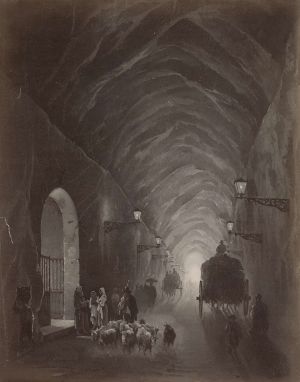
* The Grand Tunnels – Massive arterial tunnels that serve as the city's primary thoroughfares, linking major districts together. These passages are wide enough for entire caravans of goods and workers to travel through.
When the [[Orinilure Collective]] was formed in 230 ME, the city became its capital. During the Age of Deep Roads (150 – c. 500 ME) the Grand Tunnels were cut and the city was linked to the other settlements of the range and to [[Khamria]]. The war of 626–633 ME with the [[Erden Monopoly]] did not reach the city.
* The Deep Halls – The oldest, most sacred tunnels, where the first Minthari carved their homes. These halls are densely packed with winding burrows, forming a complex honeycomb of living spaces.
|Districts=The city has six districts.
* The Forge Caverns – Gigantic underground smelting chambers harnessing geothermal vents to produce weapons, tools, and armor. These caverns are lined with natural lava tubes, providing an endless source of heat.
* The Flowing Market – A sprawling subterranean bazaar carved into a network of interwoven chambers, where traders exchange goods in winding, tunnel-like stalls.
* The Ember Vaults – A series of deep, reinforced mineral veins, where the Minthari store their most valuable resources, including mithril, adamantine, and historical relics.
* The Council Burrow – A vast, highly secure chamber, where the ruling Minthari leaders gather to govern and settle disputes. Unlike the surface-world halls of power, this space is low-lit, resonant, and designed to amplify subsonic communication.
Because Minthal is entirely underground, the city's layout is three-dimensional, with tunnels extending upward and downward in complex layers. The Minthari navigate using vibration-sensitive organs, allowing them to move seamlessly through the twisting tunnels that would leave most outsiders lost.
* '''Saner''' – The oldest quarter, built in the caverns where the first settlers sheltered.
|History=[[File:Minthal - Forge 01.jpg|thumb|A forge in Minthal]]
* '''Basier''' – The governing quarter. The council of the Collective sits here in the Consoil.
Minthal’s origins date back to the earliest Minthari settlements. Over time, the city evolved from a series of primitive burrows into a highly structured metropolis, shaped by centuries of excavation and refinement.
* '''Ingeu''' – The forge district, where ore is smelted and worked.
* '''Biutic''' – The market district, along the Grand Tunnels.
Key historical periods:
* '''Sarbie''' – The upper district at the surface gates, where grain from the [[Orinilure Valley]] enters the city.
* '''Balis''' – The farming levels, where fungus, lichen, and livestock are raised.
* The Founding of Minthal – Ancient Minthari first carved the city from natural caverns, creating a sanctuary from surface dangers.
|Notable Locations=* [[File:Minthal_Grand_Tunnels.jpg|thumb|The Grand Tunnels]]The Grand Tunnels – The arterial tunnels of the city, which link its districts and continue as the Deep Roads. They are wide enough for caravans of goods and workers.
* The Era of Expansion – Massive tunnel networks were constructed, connecting Minthal to other settlements and forging routes for trade and mining.
* The Consoil – The hall in Basier where the governing council of the Collective meets.
* The Age of Industry – The discovery of geothermal energy and refined metallurgy allowed the Minthari to become one of the foremost underground civilizations in Adaris.
|Culture and Society=Life in the city is built around mining and the accumulation of wealth. Miners, engineers, and artisans hold high status, and those who accumulate the most wealth in a year govern the Collective for the following cycle. The Himoja of the city live among the Oinien, not in a quarter of their own, and many work on the surface on the Oinien's behalf.
|Notable Locations=Minthal is divided into multiple districts, each serving a specialized function within the city.
|Economy=The economy of the city is based on mining and metallurgy. It exports iron, copper, silver, and worked metal goods. Fungus farms, livestock, and wells within the city supply part of its food, and the rest is grain brought in from the Orinilure Valley.
|Defense and Military=The city is defended by its depth and by the gates on its tunnels and surface entrances. The Collective relies on hired mercenaries for its defense. The Oinien themselves are able to fight and serve as the city's police force.
* The Forge District – The industrial heart of Minthal, filled with smelting chambers, metalworks, and engineering workshops.
* The Deep Halls – The oldest part of the city, home to historical archives, ancestral sites, and sacred gathering chambers.
* The Flowing Market – A vast underground bazaar, where merchants trade refined metals, alchemical reagents, and rare underground delicacies.
* The Ember Vaults – Secure chambers storing the rarest and most valuable metals, including mithril, adamantine, and legendary relics.
* The Council Spire – The governing center of Minthal, where the ruling Minthari leaders convene to make decisions on trade, law, and foreign relations.
|Culture and Society=Minthal is a society built around craftsmanship, resilience, and tradition. As a subterranean species, the Minthari have developed unique customs and a deep connection to their environment.
* Communal Work & Craftsmanship – Every Minthari contributes to the city's maintenance, with skilled artisans, miners, and engineers holding high social status.
* Bond with the Stone & Fire – The Minthari view the earth and molten veins as both a source of sustenance and a spiritual force. Their rituals often involve stone carving, metalworking, and fire-based ceremonies.
* A Language of Vibrations – Due to their worm-like physiology, the Minthari primarily communicate through subsonic vibrations and resonant echoes within tunnels, though they also use a written script.
* Isolationist Yet Pragmatic – While Minthari prefer to remain underground, they maintain selective trade relations with surface dwellers through trusted intermediaries.
|Economy=Minthal thrives on mining, metallurgy, and subterranean resource management.
* Ore & Metal Trade – The city exports high-quality iron, copper, silver, and rare minerals, sought after by weapon forgers and artisans across Adaris.
* Geothermal Energy Use – Unlike many surface societies, Minthal relies on lava vents and steam energy, making it a self-sufficient power hub.
* Tunnel-Based Agriculture – Specialized mushroom farms, fungus-based livestock, and underground water filtration systems sustain the Minthari.
* Alchemical Production – The Minthari extract minerals for potent alchemical substances, enhancing their tools, armor, and medicinal supplies.
Orinilure City is the capital of the Orinilure Collective and the largest city in Orinilure, with about 70,000 inhabitants. It is an underground city of chambers and tunnels in the southern Orinilure Mountains. Most of its people are Oinien, and Himoja live among them. It is the political and economic center of the Collective and a major center of mining and metalworking.
Etymology
The city is named for the region. Orinilure is Arânzeni in origin and means "land of the booming voice".
Geography
Orinilure City lies in the southern part of the Orinilure Mountains, north of Biulu and south of Lirandi. It is entirely underground. The city is built on several levels, with tunnels running above and below one another and joined by ramps and shafts. Its main thoroughfares are the Grand Tunnels, which are part of the Deep Roads.
The Oinien are nearly blind and find their way through the city by echolocation. Chimes mark junctions and important buildings, and floors are textured differently from one street and district to the next.
History
The site was a set of natural caverns with passages left by the Namuril from the Great Erosion. The settlers who entered the Orinilure Mountains in 150 ME took shelter there, and the city was founded in 152 ME as their first settlement in the range. It grew outward and downward from these caverns over the following centuries.
When the Orinilure Collective was formed in 230 ME, the city became its capital. During the Age of Deep Roads (150 – c. 500 ME) the Grand Tunnels were cut and the city was linked to the other settlements of the range and to Khamria. The war of 626–633 ME with the Erden Monopoly did not reach the city.
Districts
The city has six districts.
Saner – The oldest quarter, built in the caverns where the first settlers sheltered.
Basier – The governing quarter. The council of the Collective sits here in the Consoil.
Ingeu – The forge district, where ore is smelted and worked.
Biutic – The market district, along the Grand Tunnels.
Sarbie – The upper district at the surface gates, where grain from the Orinilure Valley enters the city.
Balis – The farming levels, where fungus, lichen, and livestock are raised.
Notable Locations
The Grand TunnelsThe Grand Tunnels – The arterial tunnels of the city, which link its districts and continue as the Deep Roads. They are wide enough for caravans of goods and workers.
The Consoil – The hall in Basier where the governing council of the Collective meets.
Culture and Society
Life in the city is built around mining and the accumulation of wealth. Miners, engineers, and artisans hold high status, and those who accumulate the most wealth in a year govern the Collective for the following cycle. The Himoja of the city live among the Oinien, not in a quarter of their own, and many work on the surface on the Oinien's behalf.
Economy
The economy of the city is based on mining and metallurgy. It exports iron, copper, silver, and worked metal goods. Fungus farms, livestock, and wells within the city supply part of its food, and the rest is grain brought in from the Orinilure Valley.
Defense and Military
The city is defended by its depth and by the gates on its tunnels and surface entrances. The Collective relies on hired mercenaries for its defense. The Oinien themselves are able to fight and serve as the city's police force.