Revision as of 20:42, 8 October 2026 by Oros(talk | contribs)(Rewrite to current canon: Collective capital, districts, history; Orinilure templates; form fields only)
Orinilure City is the capital of the Orinilure Collective and the largest city in Orinilure, with about 70,000 inhabitants. It is an underground city of chambers and tunnels in the southern Orinilure Mountains. Most of its people are Oinien, and Himoja live among them. It is the political and economic center of the Collective and a major center of mining and metalworking.
Etymology
The city is named for the region. Orinilure is Arânzeni in origin and means "land of the booming voice".
Geography
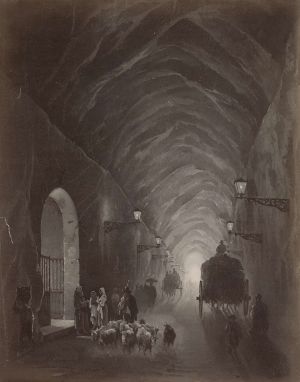
Orinilure City lies in the southern part of the Orinilure Mountains, north of Biulu and south of Lirandi. It is entirely underground. The city is built on several levels, with tunnels running above and below one another and joined by ramps and shafts. Its main thoroughfares are the Grand Tunnels, which are part of the Deep Roads.
The Oinien are nearly blind and find their way through the city by echolocation. Chimes mark junctions and important buildings, and floors are textured differently from one street and district to the next.
History
The site was a set of natural caverns with passages left by the Namuril from the Great Erosion. The settlers who entered the Orinilure Mountains in 150 ME took shelter there, and the city was founded in 152 ME as their first settlement in the range. It grew outward and downward from these caverns over the following centuries.
When the Orinilure Collective was formed in 230 ME, the city became its capital. During the Age of Deep Roads (150 – c. 500 ME) the Grand Tunnels were cut and the city was linked to the other settlements of the range and to Khamria. The war of 626–633 ME with the Erden Monopoly did not reach the city.
Districts
The city has six districts.
Saner – The oldest quarter, built in the caverns where the first settlers sheltered.
Basier – The governing quarter. The council of the Collective sits here in the Consoil.
Ingeu – The forge district, where ore is smelted and worked.
Biutic – The market district, along the Grand Tunnels.
Sarbie – The upper district at the surface gates, where grain from the Orinilure Valley enters the city.
Balis – The farming levels, where fungus, lichen, and livestock are raised.
Notable Locations
The Grand TunnelsThe Grand Tunnels – The arterial tunnels of the city, which link its districts and continue as the Deep Roads. They are wide enough for caravans of goods and workers.
The Consoil – The hall in Basier where the governing council of the Collective meets.
Culture and Society
Life in the city is built around mining and the accumulation of wealth. Miners, engineers, and artisans hold high status, and those who accumulate the most wealth in a year govern the Collective for the following cycle. The Himoja of the city live among the Oinien, not in a quarter of their own, and many work on the surface on the Oinien's behalf.
Economy
The economy of the city is based on mining and metallurgy. It exports iron, copper, silver, and worked metal goods. Fungus farms, livestock, and wells within the city supply part of its food, and the rest is grain brought in from the Orinilure Valley.
Defense and Military
The city is defended by its depth and by the gates on its tunnels and surface entrances. The Collective relies on hired mercenaries for its defense. The Oinien themselves are able to fight and serve as the city's police force.